

Riders Club App
When planning the implementation of a community-driven business model, we cannot overlook two key elements: the activity we want to support through this approach and the community itself — a community that must be built and that will ultimately help achieve this goal.
While the nature of the business activity and the way it is managed are topics for another time and place, it is worth taking a closer look at the methods used to build an external community of enthusiasts.
Traditionally, engaging customers in post-sales activities has been based on conventional communication channels or existing social media platforms. Online forums, although historically one of the most important elements in building such groups, are today largely an underused tool by brands. Both companies and users themselves often perceive them as a relic of a bygone era rather than as a solution capable of genuinely supporting the creation of an engaged community.
Currently, the dominant role in community building is played by platforms owned by Meta Platforms, Inc. While the influence of YouTube on purchasing decisions and consumer behaviour remains undeniable, it is difficult not to notice that Google’s social solutions have never achieved a comparable level of engagement. The features introduced over time are often fragmented and inconsistent, meaning they rarely become a natural environment for building relationships between users. This situation somewhat resembles the history of the now-defunct Google+ platform.
Of course, TikTok also deserves a mention. However, in the automotive industry, the nature of the platform and the communication style that dominates it do not always align with the expectations of existing customers. It is also worth noting that younger generations, who represent the largest user group on this platform, increasingly view automotive topics as less central to their interests.
A solution tailored to specific needs
Although a significant part of community activities can be built around ready-made platforms such as Facebook or Instagram — particularly their built-in tools for creating groups and events — these solutions also come with important limitations.
The enormous variety and nature of content published on these platforms make it easy for users to lose focus on materials related to a specific brand. The sheer size of a group, where many members often join accidentally rather than intentionally, instead of strengthening the feeling of belonging and engagement, can in many cases produce the opposite effect. Rather than creating a sense of a coherent community, users may feel they are simply part of a random and chaotic collection of individuals.
Additionally, building a community around a Facebook group has become a well-known and relatively simple approach, which makes it increasingly difficult to stand out. Of course, effectively engaging existing members and consistently attracting new participants remains a much broader and more interesting challenge.
Although today’s topic concerns a smaller-scale social platform, the objectives it aims to achieve are already entirely serious.
MVP, but in a different way
The minimum set of functionalities assumed for an application supporting community development — in this case, a community built around Royal Enfield users — is based on activities that are already taking place today.
The focus is primarily on organising events, distributing information about them, and enabling communication both with participants and between members of the community themselves. At first glance, these are tasks that appear to fully overlap with the capabilities offered by platforms such as Facebook.
The difference, however, lies in the way these tools are used. While open, general-purpose social media platforms make it possible to reach a broad audience, they are significantly less effective as an environment for building lasting and authentic relationships between community members.
The planned solution was never intended to completely replace the “human factor”. Its primary purpose was to support company employees, reduce operational workload, and transfer a greater share of community activity directly to its members. Although this assumption has since expanded, it remains the foundation of the entire project.
It is worth noting, however, that compared to the originally planned MVP, the project has evolved significantly. It now includes a much broader range of functionalities and possibilities than initially anticipated.
Riders Club App
Although concepts themselves can have value comparable to fully implemented products, I personally place great importance on their tangible manifestations. At the same time, it is difficult to expect solutions to previously described challenges to appear without taking concrete action. Therefore, the time has come to move from assumptions and discussions towards actual design and implementation.
Official Riders Club module
At this point, it is important to acknowledge that the concept of building Riders Clubs within the Royal Enfield brand ecosystem not only exists but is also actively being developed. The challenge, however, remains the coordination and execution of these initiatives in markets that are currently of lower strategic priority for the brand — including Poland.
Although a rides and clubs module exists on the Polish version of the official Royal Enfield website, it has still not received the necessary improvements and, in practice, remains a largely dysfunctional solution.
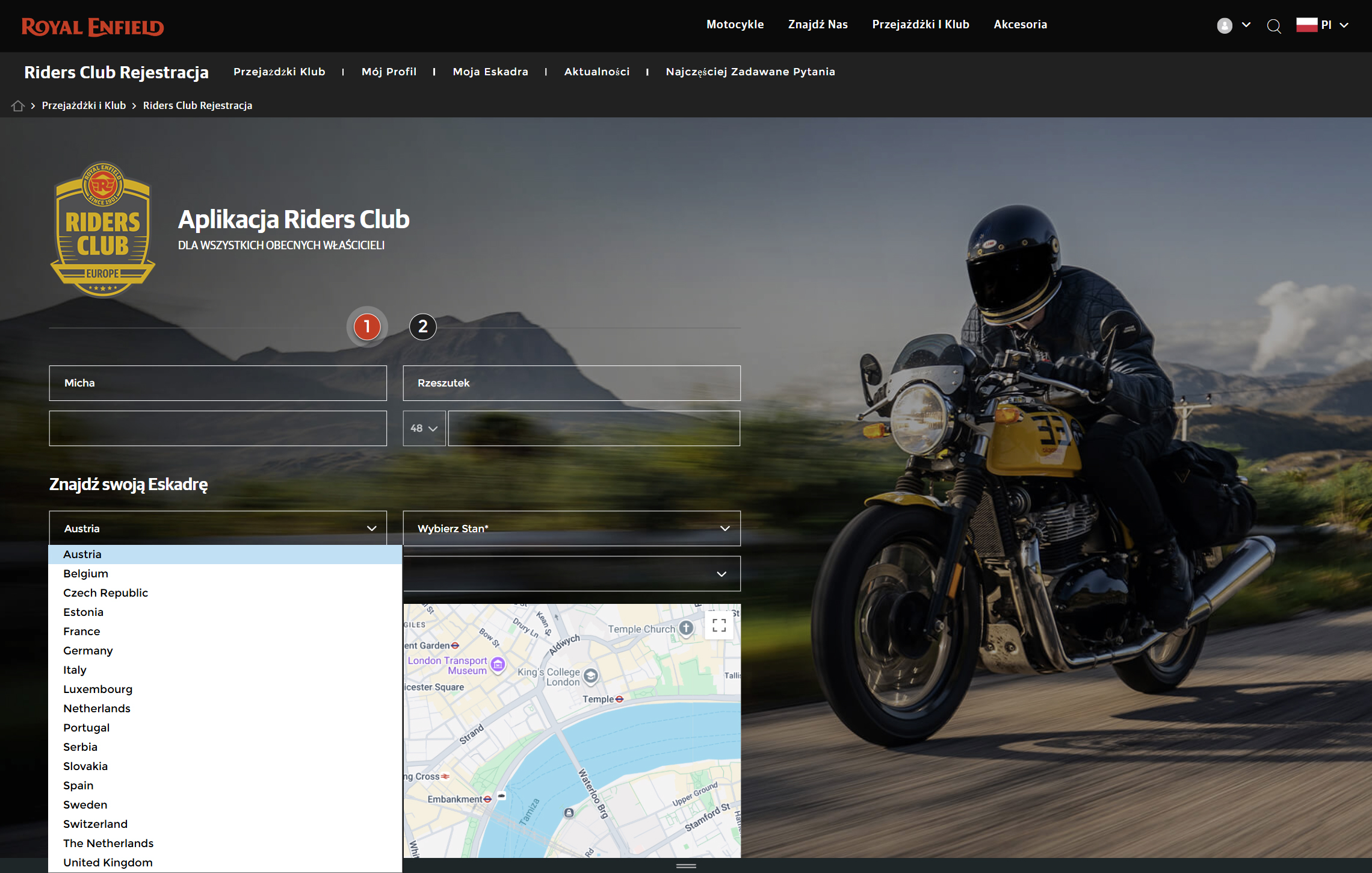
The inability of Polish users to join clubs not only prevents the feature from fulfilling its intended purpose but may also create negative impressions among potential participants. It can suggest a lack of consistency in the brand’s activities, insufficient attention given to local communities, or a gap between the communicated vision and the solutions actually available to users.
A properly functioning, global, centrally managed Riders Club platform remains the ideal and most promising long-term solution, especially considering the international nature of these communities. The challenge is that time works against us — while the need to build an engaged community already exists today.
An independent application can therefore also serve as a practical testing environment, allowing different functionalities, user engagement models, and assumptions behind the broader community ecosystem to be evaluated in real-world conditions.
Technology Stack
Riders Club is, to a large extent, a proof of concept. Therefore, the selection of technologies was driven primarily by development speed and simplicity of implementation.
The solution I am personally most familiar with — and one that also powers both the official global Royal Enfield website and the Polish-language website created for Royal Enfield Poland — is the Google Firebase platform.
The stack includes Firebase Authentication for user management, Cloud Storage for storing files uploaded by application users, Cloud Functions for handling application logic, Firebase Hosting as the foundation for static application files, Realtime Database supporting real-time communication such as chat, and Cloud Firestore serving as the primary database of the platform.
In short, it provides practically everything a developer needs to build modern mobile and web applications. And this is exactly the category the Riders Club project was designed to fit into — a web application with a mobile-first approach.
Fast and affordable
Due to the limited expected lifespan of this solution — which will most likely be replaced in the future by an official Royal Enfield mobile application or an expanded version of the existing web platform — the project is not intended to be developed as a full-scale commercial product.
At the same time, it was essential to ensure accessibility for the widest possible audience, regardless of the device or operating system they use.
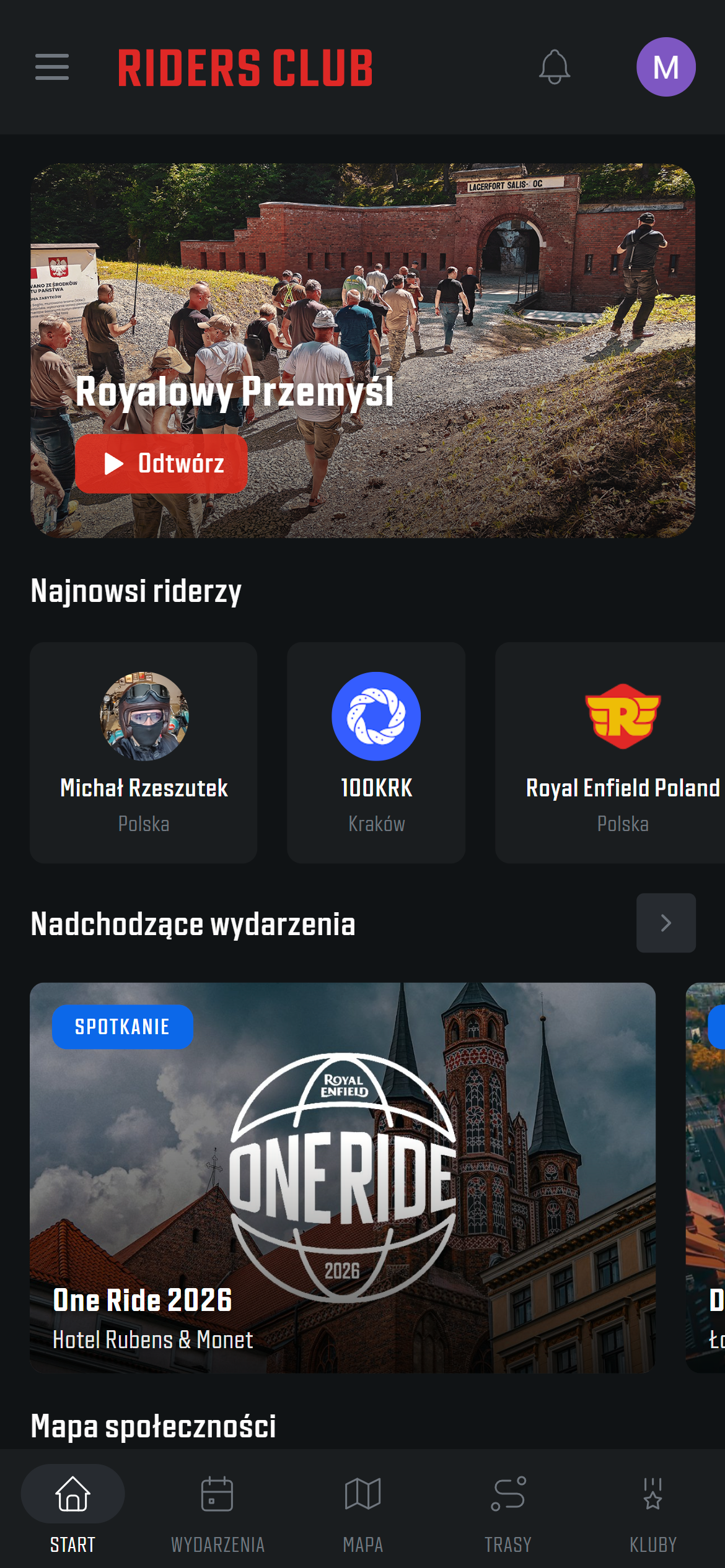
For this reason, ideas involving traditional native applications, as well as frameworks such as React Native, Flutter or the older Ionic approach, were set aside. The chosen direction became a web application enhanced with Progressive Web App (PWA) capabilities, with the possibility of further expansion through Trusted Web Activities (TWA) on Android devices.
For iOS users, three possible paths remain available: using existing APIs to create a dedicated native application, relying on the full PWA experience available through the web, or creating a native wrapper based on WKWebView.
To provide an experience as close as possible to native applications, the project uses native View Transitions and interface enhancement mechanisms such as skeleton screens. Full loader implementation is still in progress, with several subpages awaiting final integration.
The rest of the application is primarily JavaScript — and even more JavaScript — combined with the Astro framework. In this particular case, its selection was influenced more by familiarity and a certain level of dependency on the technology than by a traditional, purely analytical technology assessment :)
Current Functionality
The validity of the technology choices has been largely confirmed through practical implementation. The results became visible in less than 48 working hours, allowing the project to move from an initial concept to a functional prototype in a very short time.
At the time of preparing this description, the project provides the following functionalities:
- user registration and authentication using an email address or Google account,
- permanent account deletion directly from profile settings,
- role-based access control with the ability to grant administrator privileges to selected users,
- profile data editing, including profile picture, nickname, phone number, and personal information,
- sending and accepting friend requests,
- adding owned motorcycles displayed on the user’s profile,
- advanced privacy settings allowing users to control the visibility of their location and contact information (public, friends only, or hidden),
- switching between light and dark interface themes,
- user profiles displaying created events, published routes, joined clubs, and friend lists,
- a notification system with push notification support (currently undergoing final implementation),
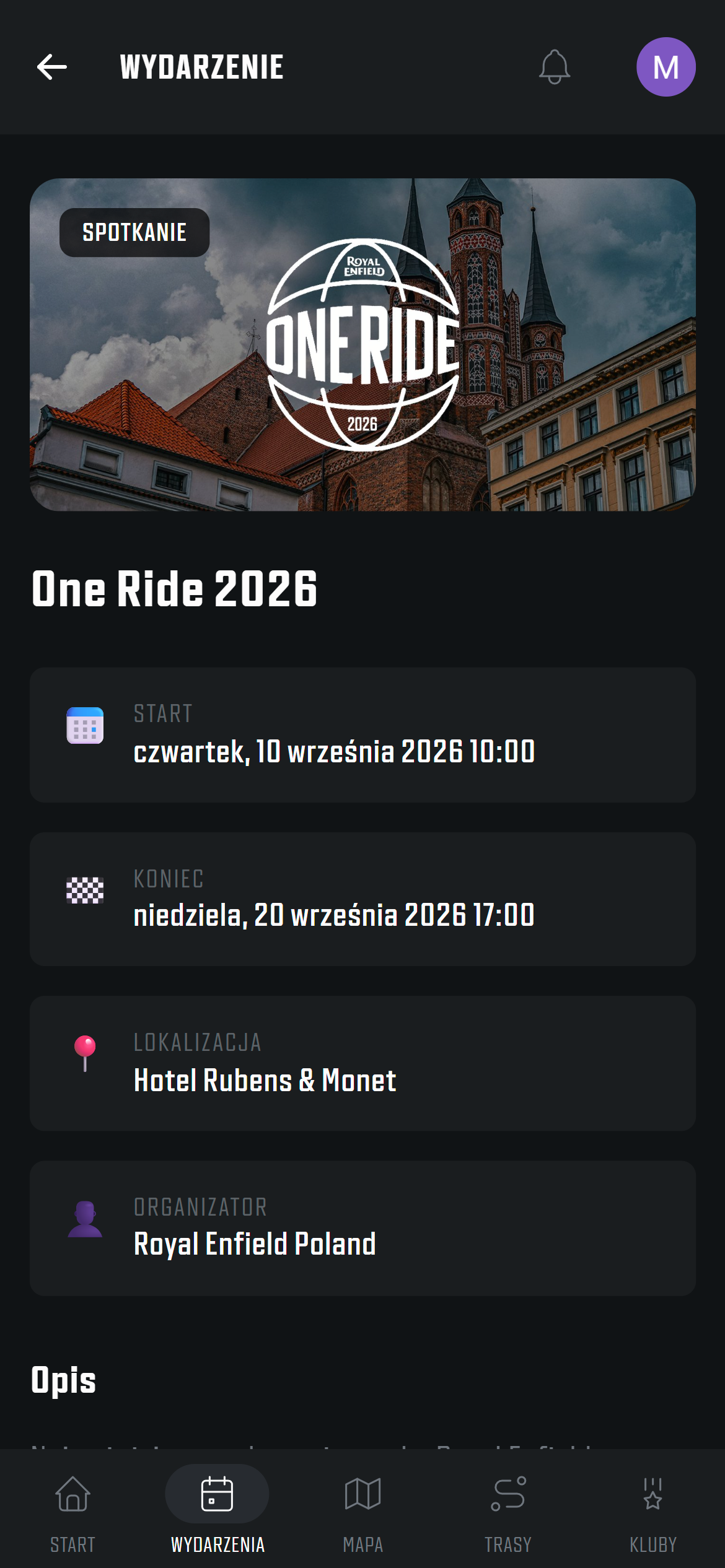
- event creation with the ability to add images, event type, date, location, RSVP functionality, and an internal chat,
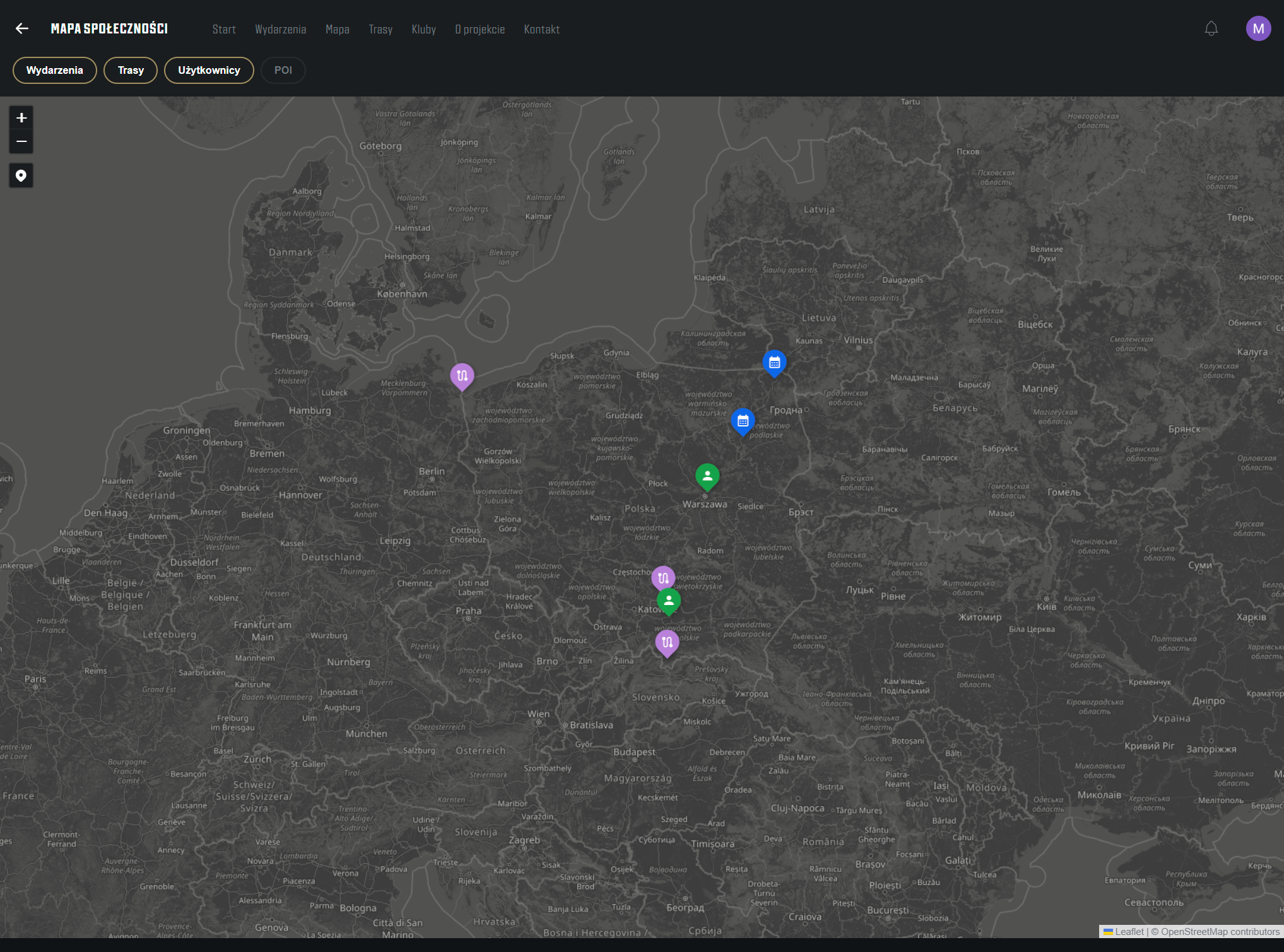
- an interactive map displaying events, user locations, routes, and various categories of points of interest (POI),
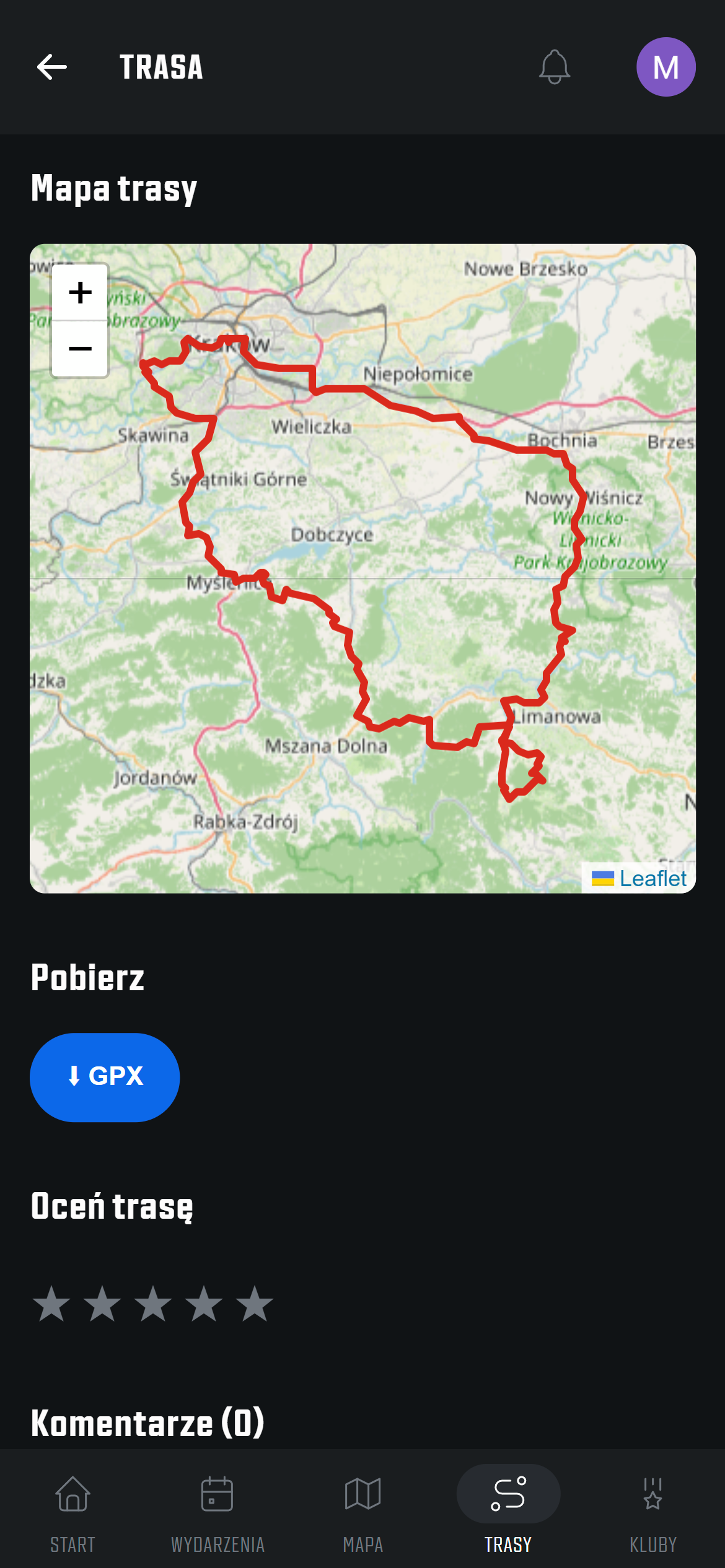
- publishing routes in GPX format with the ability to download files, view routes on the map, rate and comment on them, as well as automatically calculate distance, elevation gain, and estimated travel time,
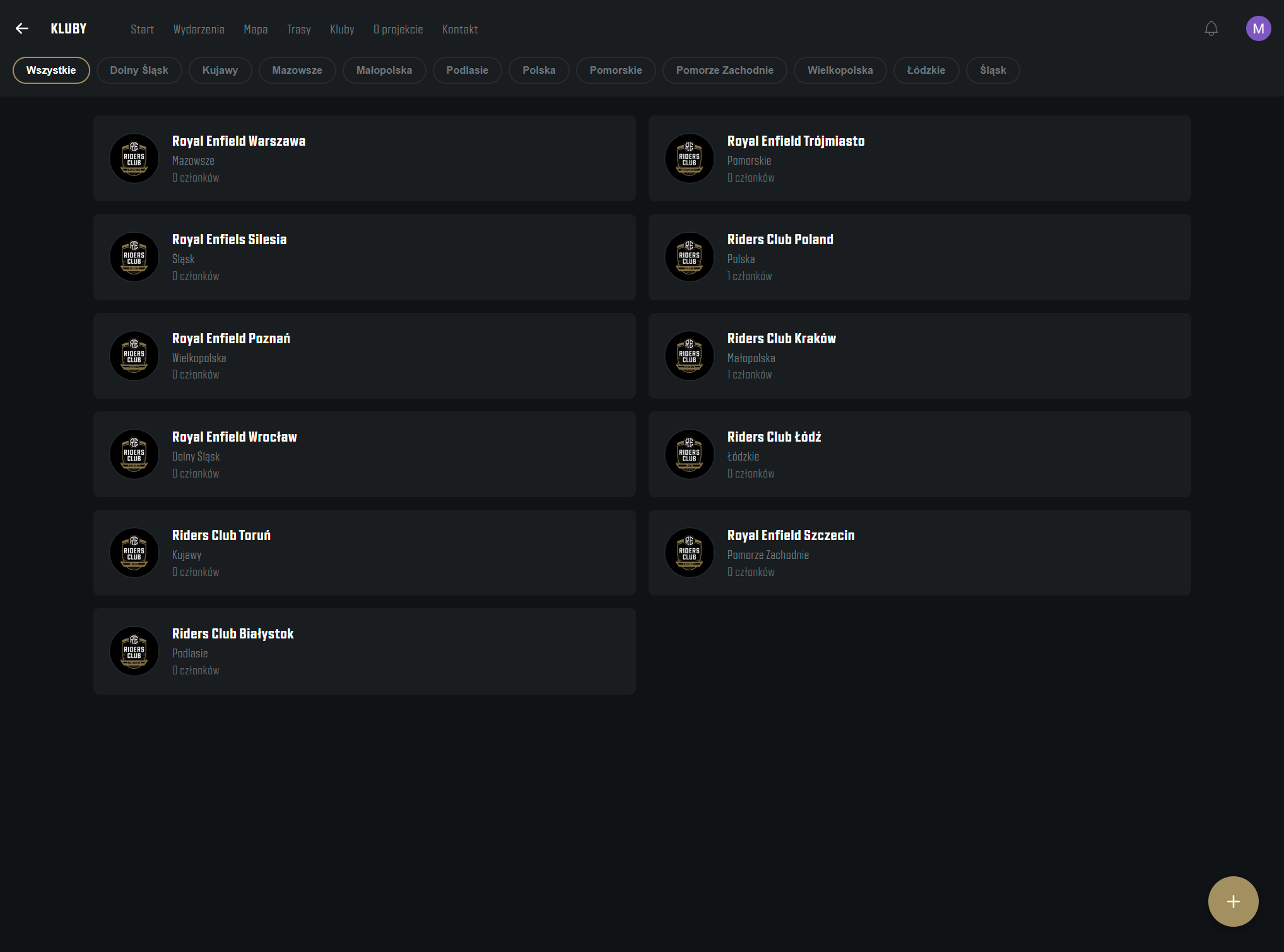
- creation of Riders Clubs with the ability for registered users to join, browse member lists, and display joined clubs on user profiles,
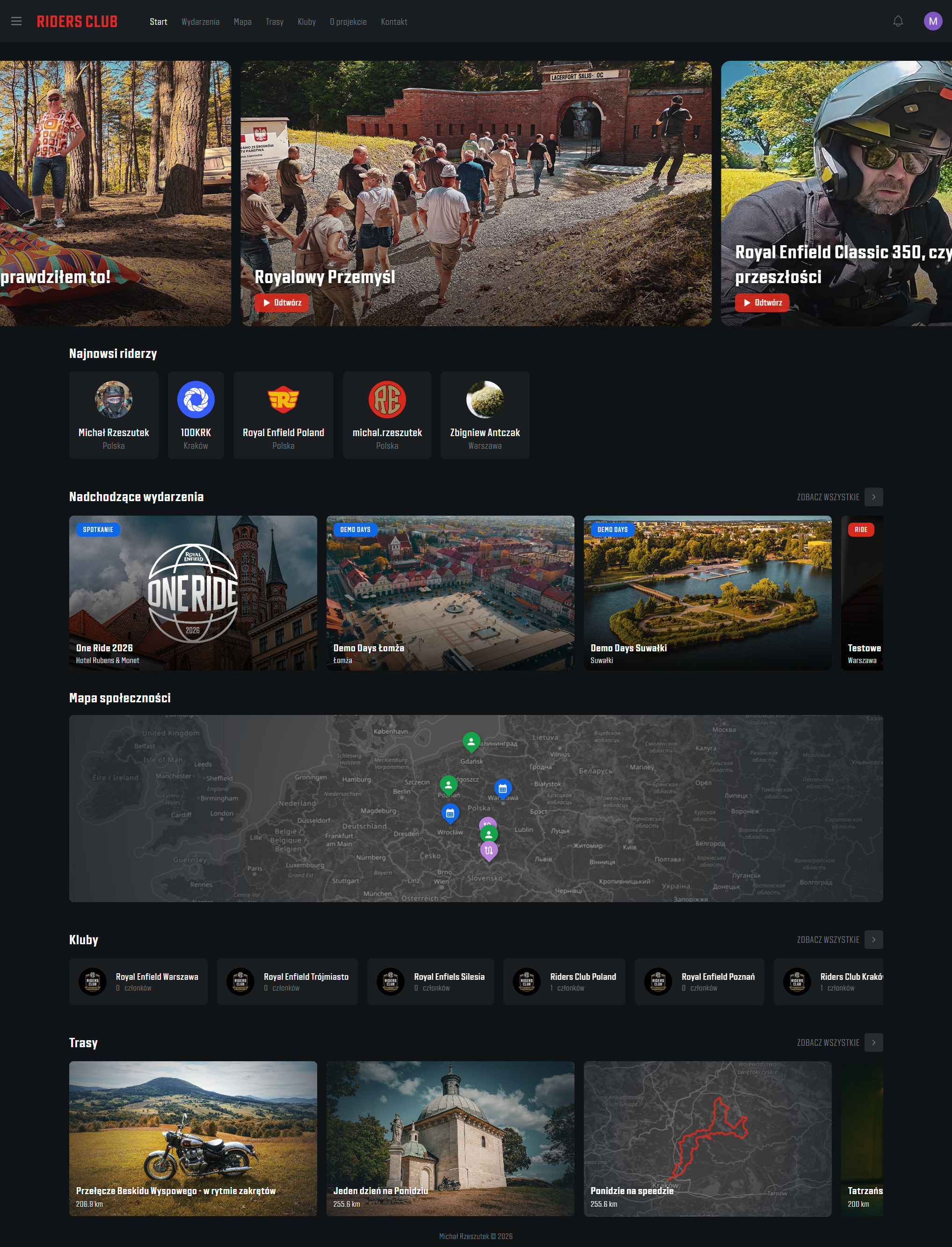
- a homepage presenting recent users, upcoming events, active clubs, and recently added routes,
- a contact page with an integrated contact form,
- a project information page explaining its purpose and concept,
- a backlink system and navigation adapted for both mobile devices and desktop environments,
- a slider presenting selected video content created by the community.
Although the list of functionalities is still incomplete, the current stage of development can already be considered highly satisfactory. This is particularly significant considering that the entire process — from developing the initial concept, designing the architecture, user interface and user experience (UX), through to implementation — took less than two weeks of work.
Furthermore, the project was developed entirely during evenings and free time outside regular responsibilities, demonstrating how much can be achieved through the right technology choices and a well-designed architecture.
Next Steps
Once the application has been refined within the currently planned scope, the next natural step will be production testing — meaning validation with the actual target audience: owners of Royal Enfield motorcycles, or, with a few adjustments, potentially riders of any motorcycle brand ;)
Of course, this is not where the story ends. In fact, it would be a waste not to explore the potential of what has already become a somewhat oversized MVP.
However, further development raises an important strategic question: which direction should future changes take? Should the application evolve into a broader, brand-independent motorcycle community platform, or should it move in the opposite direction by strengthening its connection with a specific brand and its ecosystem?
Considering the focus on Royal Enfield motorcycle users — a group I personally belong to — maintaining a close relationship with the brand and its commercial ecosystem seems to be the more appropriate approach. This is largely due to the unique character of Royal Enfield motorcycles, whose design philosophy and technical specifications differ significantly from the dominant trends in the modern motorcycle market.
The key factors are performance expectations, classic design, and the lifestyle associated with a more relaxed, slow-paced approach to motorcycling. Royal Enfield riders are not simply looking for another generic motorcycle community. They need a dedicated environment adapted to their specific expectations, riding style, and shared values.
Since a platform aimed at Royal Enfield owners naturally benefits from a strong relationship with the manufacturer and dealer network, the logical direction is not separation, but rather deeper integration and the creation of a complete Royal Enfield ecosystem.
Following this approach — and listening to the rhythm of classic motorcycle engines rather than chasing purely performance-oriented trends — the next step should be expanding existing functionalities with features tailored specifically to the characteristics of the motorcycles and their users.
Potential improvements include:
- enriching routes and events with the ability to define preferred motorcycle types or the expected pace of a ride, ensuring that riders of faster 650cc models do not become frustrated while waiting for owners of smaller-capacity motorcycles,
- creating dedicated event categories for adventure-oriented riding, such as activities connected with the Himalayan model family,
- creating groups dedicated to specific riding styles, interests, or motorcycle categories within the Royal Enfield range.
Target Functionality
The possibilities for further development and validation of more ambitious concepts extend far beyond the current functionality set. A community platform creates opportunities to implement solutions that are still relatively uncommon in the motorcycle industry — especially when they are designed as long-term initiatives integrated into users’ everyday activities.
Most of these concepts have already been described in greater detail in a previous article focused on community-driven business models. Below are several examples of functionalities that could be introduced during future stages of the project’s development.
Gamification
One of the greatest strengths of any community is its ability to self-organise. However, maintaining user engagement over the long term requires appropriate motivation. Even the most active communities eventually lose momentum if they lack incentives encouraging continued participation.
Gamification is a natural solution, especially when it goes beyond the satisfaction of achievements and provides tangible benefits.
In the case of Riders Club, such a system could reward activities including:
- publishing photos and video content,
- adding routes and events,
- commenting on and rating content,
- participating in events,
- helping other users,
- maintaining regular activity within the community.
Traditional elements such as experience levels, badges, or ranks would only form the foundation of the system. Much greater value could be created by periodically rewarding the most active members with motorcycle accessories, apparel, merchandise, discounts, invitations to brand events, or early access to selected initiatives.
Importantly, some of these activities are already included in official guidelines for the operation of Riders Clubs. In practice, however, their implementation remains limited, and — more importantly — there are currently no dedicated tools allowing activity to be systematically measured and the most engaged community members to be recognised fairly.
Drop Zone
The sale of limited-edition motorcycles and accessories has been part of Royal Enfield’s strategy for many years. Each year brings at least one opportunity to acquire a model available in a strictly limited quantity.
To make participation in such launches easier, the brand created the Drop Zone application, designed to inform users about upcoming sales. This functionality has since been integrated into the official Royal Enfield application.
The problem is that, like many other elements of the recently redesigned application, it is not available to users in Poland.
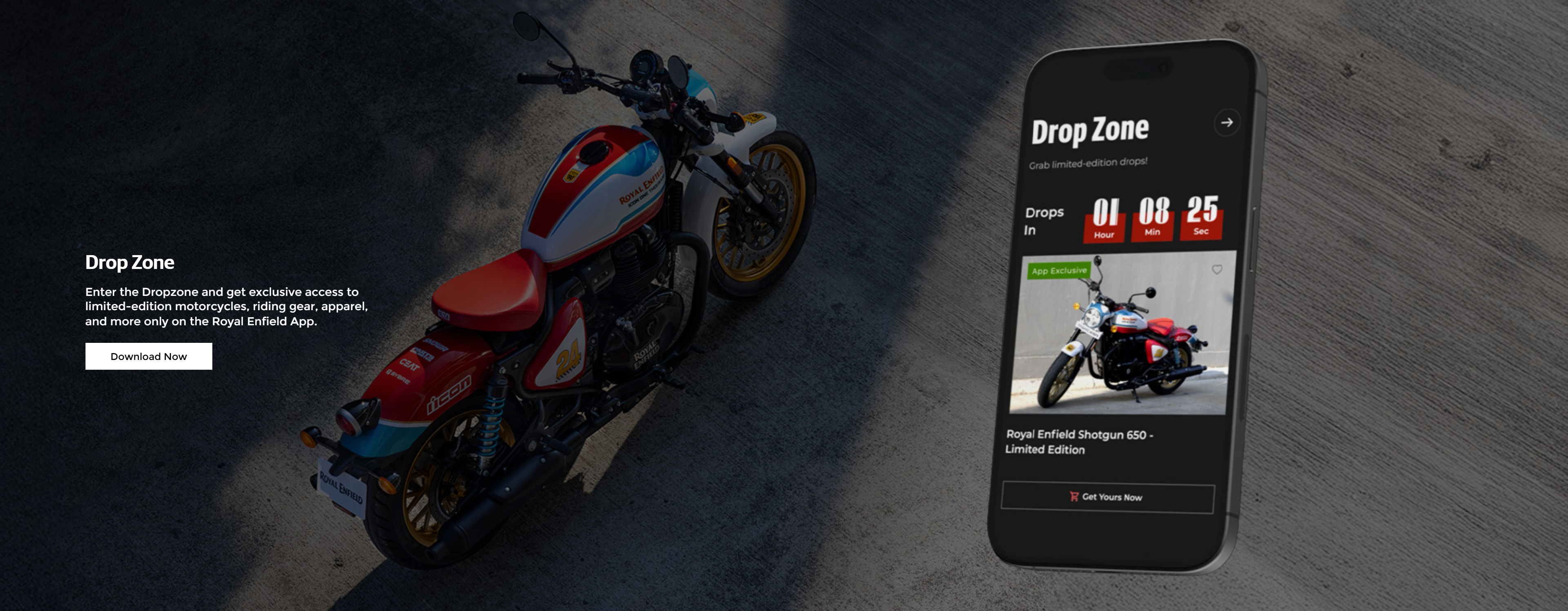
This is precisely where Riders Club could effectively fill an existing gap. While the actual purchase process for limited-edition motorcycles often relies on dedicated forms and systems that an application cannot replace in its current state, there is no obstacle preventing it from becoming a central information hub for upcoming launches.
Push notifications, countdowns to the start of sales, information about registration rules, or reminders about approaching deadlines would allow the most interested users to receive relevant information at exactly the right moment.
The members of the community who actively engage with the brand every day should be the first to receive information about events, launches, and limited-edition products. This approach not only increases participation in sales initiatives but, more importantly, strengthens the sense of belonging and builds a deeper relationship between the brand and its most dedicated customers.
Gamification Elements
A social application that is always available at hand and takes advantage of the capabilities of modern smartphones opens completely new possibilities for activating users. Most mobile devices today are equipped with GPS modules, cameras, internet connectivity, and notification systems, allowing the creation of experiences that go far beyond simple points, badges, or achievement systems.
The ability to track user locations, capture photos and videos, publish stories, and communicate with other community members allows gamification to move beyond the phone screen and into the real world. As a result, participants do not simply collect virtual achievements — they gain a genuine reason to get on their motorcycles and explore new places.
This creates opportunities for activities focused on discovering locations selected by the community, visiting the most interesting points across Poland and Europe, documenting journeys, inspiring other users, and collectively building a database of unique destinations.
A good example would be popular activities such as Photo Scavenger Hunts or broader Geolocation Games, adapted specifically for the motorcycle community. The organiser publishes a photograph showing a distinctive location without revealing its exact position. Participants must identify the place, ride there, and confirm their visit by submitting their own photograph. The first person to discover the location could earn the right to publish the next challenge or receive additional points in the ranking.
This type of activity could continue throughout the entire riding season, gradually strengthening community engagement. At the end of the season, the most active participants could be rewarded by the brand supporting the project — regardless of whether success is measured by the number of locations visited, the speed of completing challenges, or another predefined ranking system.
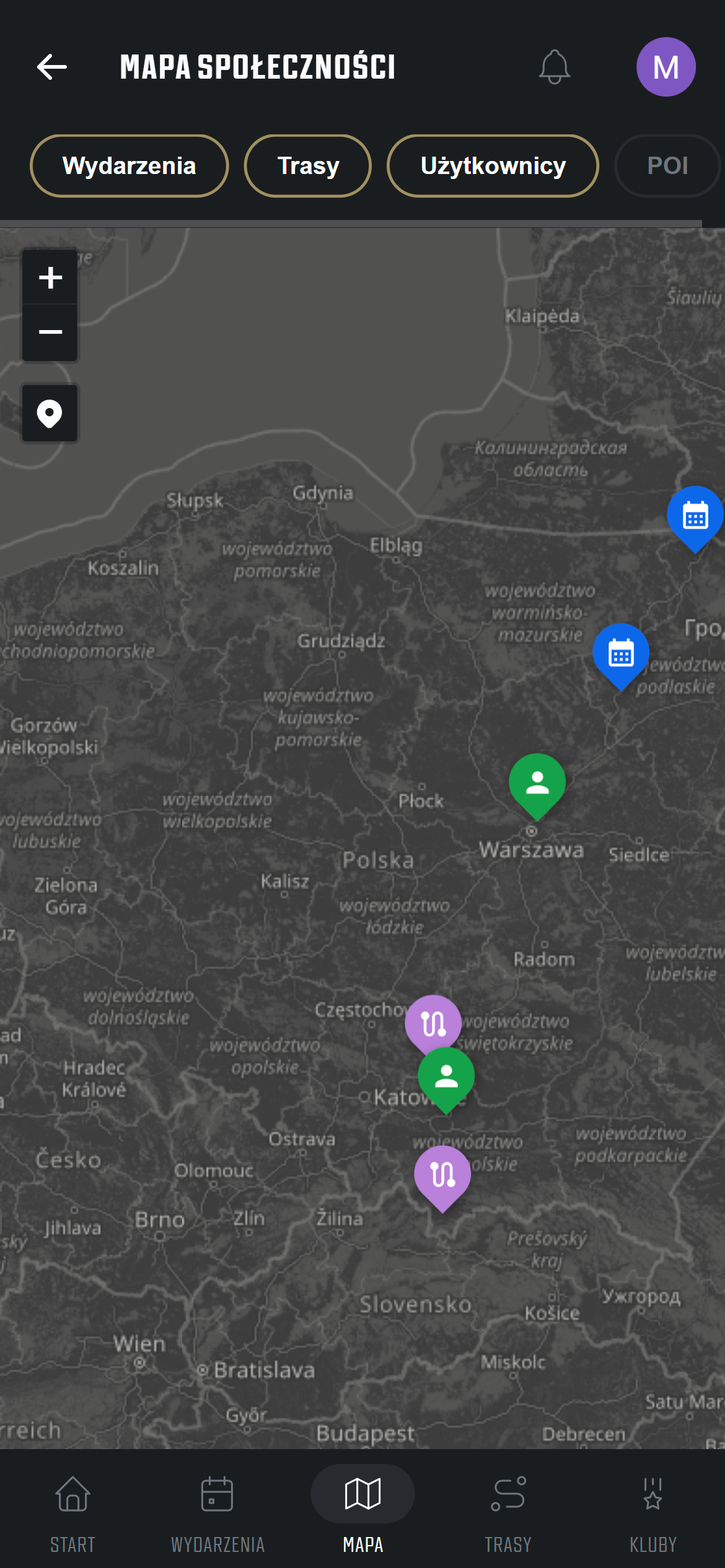
This is only one example of how modern smartphone capabilities can be used. Combining location services, cameras, maps, notifications, and social features creates enormous opportunities for building engaging experiences that would be difficult to achieve through traditional communication channels alone.
RE.View
One of the projects aligned with the idea of community building is RE.View — a concept developed almost two years ago and only recently published. Its main objective is to create a transparent and accessible system that enables longer motorcycle test rides for people interested in preparing photographic materials, videos, or reviews featuring Royal Enfield motorcycles.
The project is also intended to encourage users to share authentic experiences connected with the brand and its motorcycles. Instead of relying exclusively on content created by the manufacturer, a greater role would be given to stories, opinions, and materials produced by the community itself.
In the context of the Riders Club application, this functionality is a natural candidate for integration. Publishing materials created by programme participants, allowing the community to rate them, presenting the most interesting stories on the homepage, and periodically recognising the authors of the best contributions could become a natural part of the wider ecosystem.
As a result, the application would no longer serve only as a tool for organising events. It could also become a platform showcasing the most valuable content created by riders themselves.
Ultimately, the key idea behind these features is simple: a smartphone is not the goal itself — it is a tool that allows community activity to move from the digital environment into the real world. This is what makes gamification particularly valuable in the context of Riders Club: it connects online engagement with actual riding experiences, exploration, and shared passion.
CommunitySystem
One of the most important aspects — and something that has been present in my thinking from the very beginning — is the possibility and necessity of creating a system that organizes information and communication between individual elements of a brand’s communication platform.
Currently, most brand websites, especially in the automotive industry, still operate within a rather outdated model — as closed platforms limited almost exclusively to one-way communication. Although the concept of Web 2.0 was widely discussed as early as the late 1990s, more than a quarter of a century later many automotive websites still do not utilize even the basic functionalities that should be considered a standard today.
In the case of the royalenfield.pl website that I am developing, the situation is similar. However, this is primarily the result of the scale of ongoing activities and the number of parallel initiatives being managed, rather than a lack of willingness or a deliberate decision to avoid such solutions. For this reason, the Riders Club API has been designed from the very beginning as a layer enabling two-way communication between the official Royal Enfield Poland platform and the Riders Club community application.
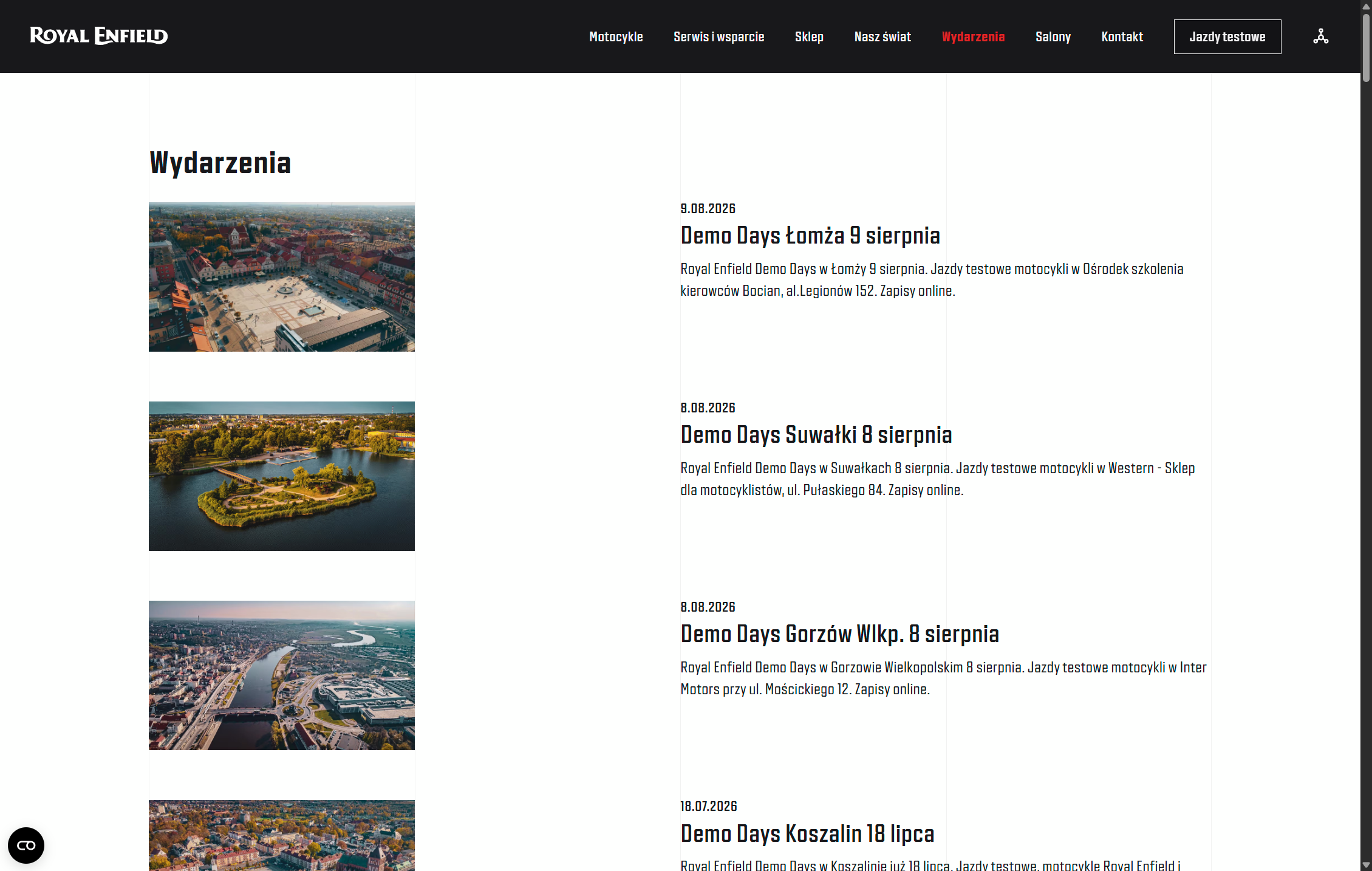
At the most basic level, this primarily concerns the exchange of information related to events. There is no technical obstacle preventing royalenfield.pl from displaying community-driven events in a dedicated section, tab, or subpage, while at the same time allowing official brand events to be available within the Riders Club application.
Such an approach allows the traditional model of a brand website — functioning only as an information channel — to evolve into a connected ecosystem where the brand and its community mutually complement each other. After the full implementation of Riders Club modules, similar to the functionalities currently available on the central royalenfield.com website (which, however, do not yet fully utilize their potential), the official website can become a truly living platform, continuously enriched by community activity.
As a result, visitors to the brand’s website would receive not only marketing messages but also a genuine representation of an active community: people, events, routes, and shared experiences. This demonstrates that the Royal Enfield community is not merely a marketing concept or communication tool, but a real value created together by the brand and its users.
Time to Get Back to the Keyboard
In my opinion, the Riders Club project deserves further development. Not because it is simply another social application, but because it addresses specific challenges and provides real value to a clearly defined group of users. It was created with the motorcycle community in mind, and the needs of that community have shaped its direction from the very beginning.
In a world that will likely become increasingly saturated with SaaS products in the coming years — often created simply because building such solutions has become easier than ever before — working on a project with a clearly defined purpose and real users is a refreshing change.
This does not mean, however, that developing such a solution comes without costs. Unlike many projects that disappear shortly after being published on GitHub, a community platform requires continuous infrastructure maintenance, security monitoring, feature development, and ensuring reliable long-term operation.
In the case of Riders Club, an additional factor is the cost associated with using the Firebase platform, which requires moving to the paid Blaze plan from the very beginning. This is simply a natural consequence of building a service intended for everyday use rather than a demonstration project.
The history of software development is full of excellent ideas that never reached wider adoption solely because their creators ran out of time, resources, or support. I would like Riders Club to avoid that fate — at least until a similar solution is provided by the central Royal Enfield organisation or until the project reaches the limits of its business justification.
Therefore, alongside the work towards the first public release of the application, I intend to approach the people responsible for developing the brand’s marketing and community initiatives and present the concept for consideration.
If the idea does not find the right environment for further development, it will still remain an example of successfully transforming a concept into a functioning solution — and perhaps even confirmation that the chosen direction was justified.
Either way, it is time to get back to the keyboard.