

Motolytics
Some projects are born out of business needs. Others emerge from pure frustration. Motolytics definitely belongs to the latter.
At some point, the occasional reports on the Polish automotive market simply stopped being enough. In a world where virtually everything changes from one day to the next, publishing market data only every few months felt outdated.
There are only a handful of organizations publishing these reports, but there are even fewer sources they can actually rely on. In practice, such data can only be obtained directly from importers and dealers—or from Poland’s Central Register of Vehicles and Drivers (CEPiK).
Knowing how these datasets are structured, and how difficult it would be to collect consistent and reliable information from thousands of companies across the industry, it quickly became clear that there was only one truly trustworthy source. Before long, I had found a continuous stream of official data that could be processed and analyzed.
And once I realized the data already existed, another question naturally followed: why not build a tool that makes it faster, easier, and far more accessible to analyze?
That’s how the first interface for retrieving official vehicle registration data was born—a project I first mentioned back on January 15, 2026. Initially, it was nothing more than a small experiment built in just a few hours with the help of modern development tools. Since then, however, the project has evolved considerably. The codebase has grown substantially, and a much more complete second version is now running in production.
Interestingly, my local development environment still relies on plain JSON files. That’s probably a consequence of a few painful encounters with corrupted databases in the past. The production version, however, now runs on Google Cloud Firestore, making it possible to process significantly larger datasets while keeping the information continuously up to date.
Motolytics isn’t trying to replace traditional market reports—it aims to complement them.
The platform analyzes registration data covering virtually every category of vehicle recorded in CEPiK, including motorcycles, passenger cars, trucks, buses, agricultural tractors, and many other road and off-road vehicles.
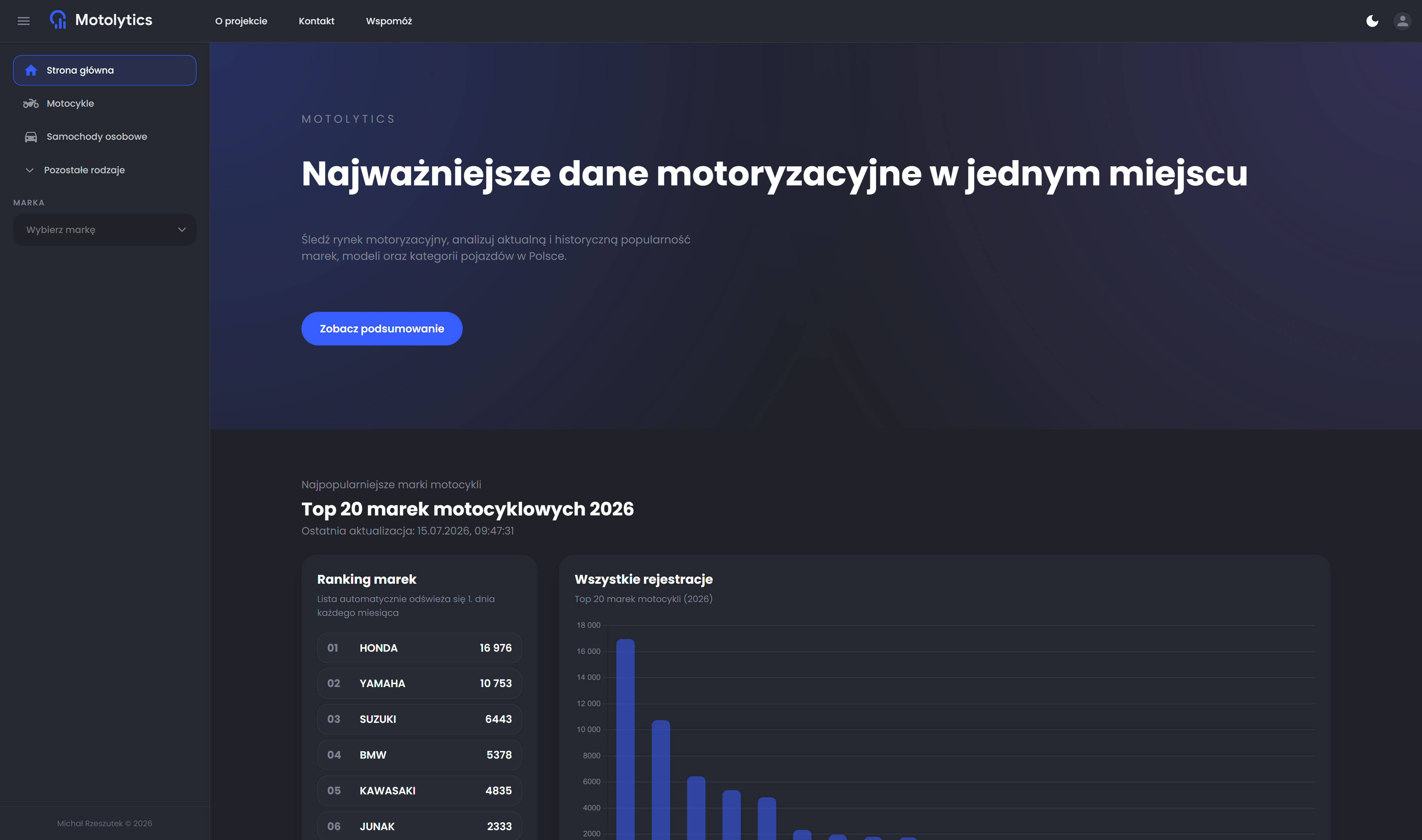
Instead of manually browsing through thousands of records, users are presented with ready-to-use statistics and rankings. For every vehicle category, the system automatically calculates the Top 50 manufacturers, making exploration much easier. Of course, less popular brands can still be analyzed simply by entering their names manually.
One of the core views is a manufacturer ranking showing which brands perform best during the current year. It may sound straightforward, but official data sources don’t provide such rankings directly. They have to be generated by aggregating and processing every individual registration record.
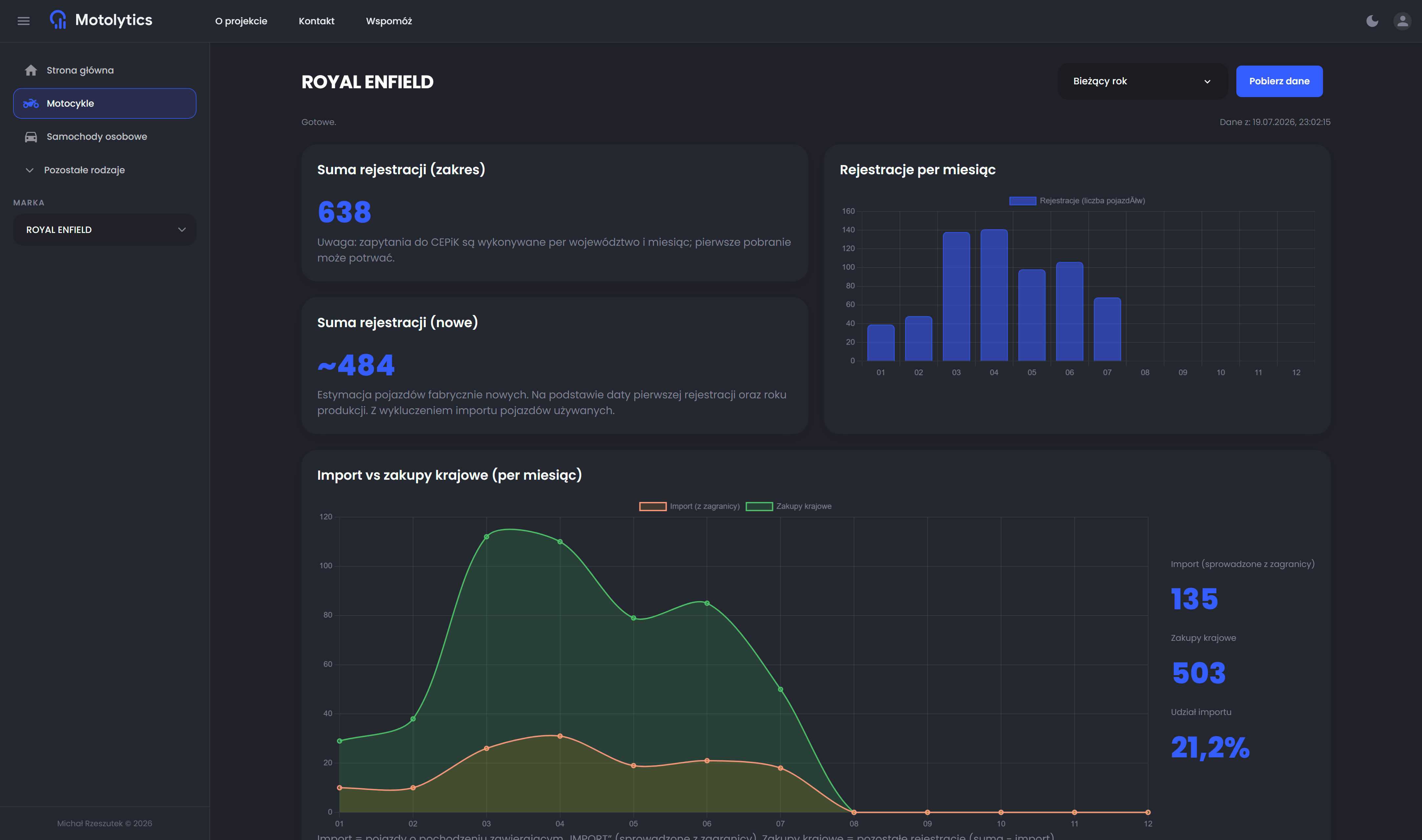
Estimating new vehicle sales is an even greater challenge. Official datasets don’t explicitly state how many vehicles were actually sold through dealerships. Motolytics estimates these values by combining first registration dates with production years while excluding imported used vehicles. This information isn’t available “out of the box”—it requires additional data processing.
Automotive Brands
Things become even more interesting once you drill down into an individual manufacturer.
For every brand, users can explore registration history dating back to 2017, discover the most popular models, analyze regional distribution across Polish provinces, compare engine displacement statistics, and examine vehicle production years.
These kinds of insights often prove much more valuable than a single figure published in an annual report. They reveal trends, seasonality, and changing customer preferences without requiring users to perform their own manual calculations.
It’s also worth mentioning that Motolytics is primarily built to satisfy my own needs. There’s no point pretending it was designed for thousands of users—it most likely never will be.
New features usually appear because I need specific information while analyzing the automotive market. Whenever I find something missing, I simply build it.
The next major milestone is an advanced brand comparison tool. I’d like users to compare manufacturers based on registrations, estimated new vehicle sales, imports, market share, and historical performance over time.
Another promising direction is market potential analysis. Rather than comparing manufacturers alone, the platform could reveal how individual regions or provinces are developing and identify where demand for specific vehicle categories is growing the fastest.
Although Motolytics remains a personal hobby project and international expansion has never been the goal, it’s difficult to imagine a modern application without multilingual support. That’s why i18n is already on the roadmap—not because it’s essential, but because it has become a standard part of contemporary software development.
Looking Ahead
At its core, Motolytics is an attempt to make existing public data genuinely useful. Instead of waiting months for market reports to appear long after the period they describe, users can analyze official information almost immediately and with far greater flexibility.
Performance remains the biggest technical challenge. CEPiK contains an enormous amount of data, and retrieving and processing it inevitably takes time. Background schedulers constantly update the database, but even they cannot completely overcome the limitations of the underlying data source.
Ironically, those very limitations are what keep the project moving forward. Every obstacle becomes an opportunity for a new feature, better optimization, or another analytical capability.
And perhaps that’s what makes Motolytics most valuable. It isn’t a finished product—it’s a project that continues to evolve alongside the questions being asked by the Polish automotive market.